Game rules versus account rules
Aviator 1xBet Pakistan: account terms to read before the first round
The multiplier, the return figure and the seed check come from Spribe and do not vary by lobby. The account, its currency, its document requests and its withdrawal ceilings come from the operator, and those are the pages to open first.
Anyone looking at 1xBet Aviator is looking at two products stacked together. Underneath sits Spribe's crash game, identical wherever it runs. On top sits a casino account whose rules are written by the operator and by nobody else.
Those rules decide nearly everything that matters about money: what currency the balance uses, when documents are requested, how much can leave per week, and whether a deposit must be played through first. They are also the part a game window never shows. This page separates the two layers and gives a way to read the second one in any lobby; it makes no claim about any particular operator's licence, terms or reach.
The part of 1xBet Aviator that belongs to Spribe
Spribe released Aviator in 2019 and supplies it to casino operators. The studio's page lists a return of 97% and describes it as a «mini game» with in-game chat, live bets and statistics. A 97% return means a house edge of 3% on everything staked, over the long run. Those studio-fixed facts anchor the wider aviator game pakistan picture kept on the home page.
Each round's result is fixed from seeds. The operator generates a server seed of 16 random symbols, and the SHA256 hash of the next one is visible to the player before play starts. Once betting closes and the round begins, that seed is joined with the players' client seeds, hashed with SHA512, and the crash point is taken from the result. Every finished round has a «provably fair» icon in the game history for checking it.
Spribe prints no top multiplier. On the fun-mode screens behind this site, rounds ended at 1.32× and at 3.59×, and one earlier round in the strip read 1,095.11×; each is simply a round that happened.
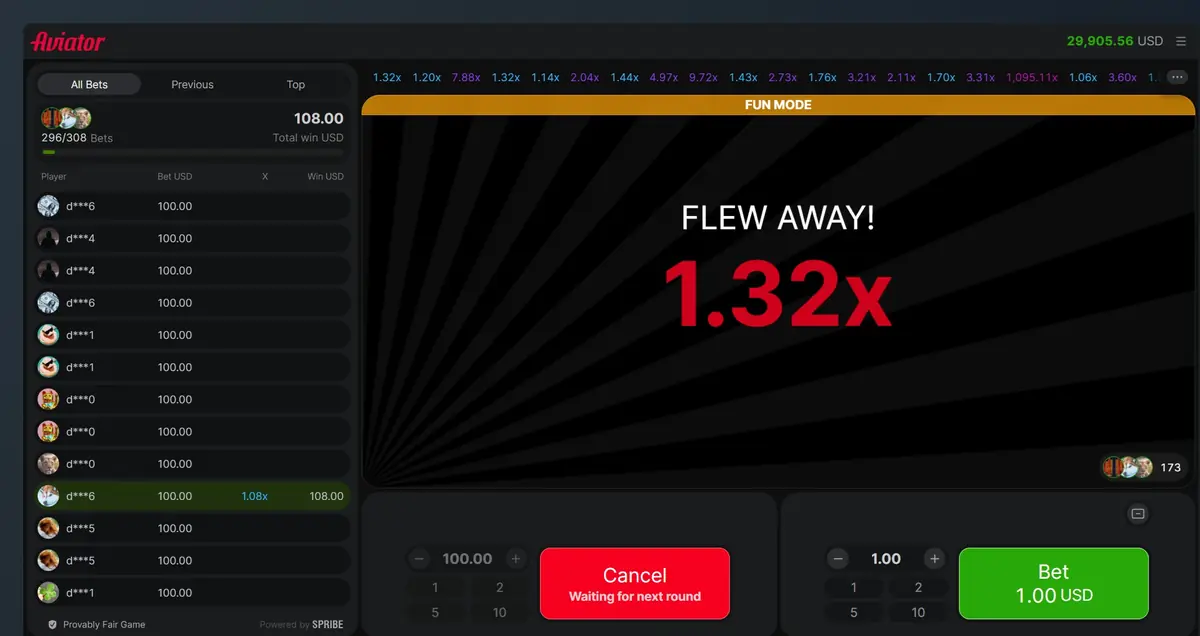 Own capture, fun mode, 7 September 2026, resized and re-encoded and otherwise untouched.
The payout rule is plain multiplication. A stake of 100.00 collected at 2.53× returned 253.00. As rupee arithmetic, Rs 2,000 collected at 3.00× would return Rs 6,000, while the same Rs 2,000 still riding when the round ends at 1.32× returns nothing.
Where the game stops and the account starts
An operator that carries Aviator has taken the studio's software into its own lobby. Everything around the round is then its decision, fixed in its terms at the moment an account is opened. The balance is money held by the operator, and the terms spell out when and how it can be taken out.
That is why two lobbies running the same round can treat the same winnings very differently. The multiplier settles what a round pays; the terms settle when that money can actually leave.
| Setting | Decided by | Found in |
|---|---|---|
| Return, seed check, round shape | Spribe | The game and its fairness page |
| Balance currency and conversion | Operator | Account and payment terms |
| Smallest and largest bet | Operator | Game limits inside the lobby |
| Document requests and their timing | Operator | Identity or verification clause |
| Withdrawal ceilings per period | Operator | Payment or withdrawal clause |
| Turnover on deposits and bonuses | Operator | Bonus and payment clauses |
Aviator 1xBet Pakistan: terms to find before the first round
Six things are worth locating in any operator's terms before money goes in. The examples come from the casinos scored on this site, with clause numbers, to show what a clear answer looks like.
When documents can be requested. Vave's cl. 8.7 allows an ID request before any payout. Hyper Lucky links its check to a trigger event (cl. 10.3, 8.13). WinDice has a clause that leaves the moment unstated (cl. 15.1).
How long there is to send them. The same Vave clause sets 14 days. A missing deadline leaves the timing open-ended.
How much can leave per period. TG.Casino writes €150,000 per rolling 30 days (cl. 9.6). Bitcasino.io allows large requests up to 1 million USDT a week (cl. 6.10). Vave sets no cap per period but may split a win from 50,000 USDT into equal instalments (cl. 8.8), and BetFury may pay wins of US$50,000 or more in parts (cl. 9.6).
Whether deposits must be played through. Vave's cl. 8.11 asks for a deposit to go round three times on casino games before a withdrawal.
Whether the licence matches the register. Metaspins cites Anjouan in its terms while the Curaçao register lists Metaspins N.V. for its domain, and the two are not reconciled. Winz.io's Anjouan entry lists its domain, but the Tobique list it also cites names companies only.
Which currency the balance uses. A figure in euros, dollars or USDT reads differently from a rupee budget, so the unit matters before the limit does.
An Aviator 1xBet Pakistan comparison built from these six lines tells far more than any lobby banner. Where a line has no answer, that blank belongs in the decision too.
1xBet Aviator odds are the game's odds
The published return belongs to the title, and the chance of a round reaching a target follows from it. That chance is about 0.97 divided by the target: roughly 80.8% for 1.20×, 48.5% for 2× and 9.7% for 10×. Rounds are independent, so a string of low results makes a high one no more likely.
Pace changes the cost, though. A round took between 10 and 30 seconds on screen, which gives 120 to 360 rounds in an hour of steady play. At Rs 100 a round, the 3% edge averages Rs 360 an hour at the slow end and Rs 1,080 at the fast end. The full working is on the page about the 97% figure.
The strip of past rounds uses blue below 10×, purple from 10× to under 100× and red from 100× upward. It is a record, not a forecast. How a single round runs covers the controls one by one.
Where the numbered list fits
The home page scores twelve casinos on five checks taken from their own terms and the licence issuer's register. A number requires two things: Aviator by Spribe showing in the casino's own lobby when checked on 16 September 2026, and terms that could be scored. The scored rows are on the ranked list, and the reasons behind each check are set out on the scoring page.
Coin payments and mobile wallets each raise their own questions. Paying in USDT or Bitcoin has a separate page.
Keeping the round in proportion
The demo on Spribe's site runs on a play balance and costs nothing, which makes it the place to learn the collect button before any account is opened. The free version shows the round but none of the account rules above.
Gambling is for adults, 18 and over. Decide a rupee amount in advance, treat it as spent, and stop at it rather than chasing losses. Gamblers Anonymous offers support internationally.