Free play, explained
The Aviator demo: free rounds that teach the controls, and what they leave out
The free version runs Spribe's round on a balance that is not money. It is the right place to learn the buttons and the pace, and the wrong place to judge a casino.
The Aviator demo is Spribe's own round attached to a balance of play credits. The studio's page for the game carries a «Play Demo» button, and the build loaded further down this page is that free version. Nothing deposited, nothing withdrawn: the credits exist only inside the game window.
That makes it useful for exactly one kind of question, the kind about how the game behaves on screen. Questions about money, accounts and casinos need other answers, and the second half of this page explains why.
What the Aviator demo is
The free version is the same title with a different balance behind it. The multiplier climbs the same way, the two bet panels work independently, and the strip of finished rounds fills up as the session goes on. The studio lists a 97% return for Aviator and publishes no top multiplier, and neither of those facts depends on which balance is attached. Anyone wanting the fuller aviator game pakistan picture beyond free play can begin on the home page.
What the credits cannot do is leave the game. A win adds to a number on the screen; a loss takes from it. There is no wallet, no cashier and no account history attached to that number.
The screens used across this site show the same interface in a casino setting. The editors captured them in Vave's fun mode on 7 September 2026, and three labels were printed on the frame: «Provably Fair Game», «Powered by SPRIBE» and «FUN MODE». Rounds on those screens took between ten and thirty seconds each.
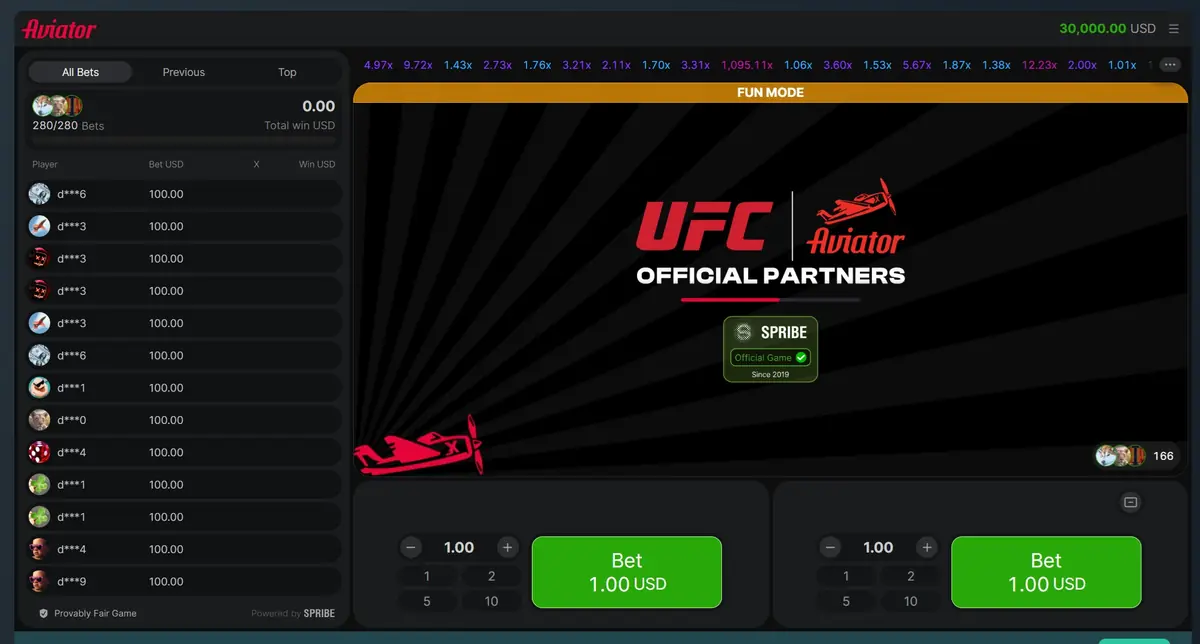 Own capture, fun mode, 7 September 2026, resized and re-encoded and otherwise untouched.
Try the game here
The button below loads Spribe's demo build into this page on a play balance. It starts only when pressed, so the page stays light for anyone who came to read.
The game loads from Spribe's own demo server on a play balance. Nothing is deposited and nothing can be withdrawn. 18+.
The free build is also the easiest place to find out whether the game suits you at all, before any account exists. A few things are worth trying in the first twenty rounds:
- Put the same small amount on both panels and collect one early, the other late. The two results arrive separately.
- Tap the quick buttons marked 1, 2, 5 and 10 and watch the amount field change.
- Watch the balance at the moment a bet is placed. On the recorded screens the amount left the balance immediately, before the climb.
- Count the rounds in five minutes. At ten to thirty seconds a round, the answer lands between ten and thirty.
What free play teaches well
The pace is the first lesson. Written down, ten to thirty seconds sounds short but manageable. After forty rounds in a row it feels different, and an hour holds between 120 and 360 of them. Feeling that speed with credits is cheaper than feeling it with rupees.
The second lesson is the collect button. The recorded screens show a bet of 4.60 collected at 2.21× paying 10.16, and 100.00 collected at 2.53× paying 253.00. Seeing how quickly a 2.53× passes, and how often a round ends at something like 1.32×, builds a realistic sense of timing.
The third is the colour strip. Blue entries sit below 10×, purple ones run from 10× to just under 100×, and red ones reach 100× or more. A red entry of 1,095.11× appeared on the recorded screens; it was one round that happened, not a limit and not a sign of what comes next.
For the rules written out step by step, see the round-by-round guide.
What the Aviator demo cannot show
Everything that decides whether money reaches a player happens outside the game window, and the free version never gets there.
Payouts. Play credits are never sent anywhere. A week of good results in free play reveals nothing about whether a casino pays, how it handles a large request, or what its caps are.
Identity checks. A demo has no account to verify. With money, the terms decide when documents are requested. Vave's cl. 8.7, for example, lets the casino ask for identification ahead of any payout; documents are then due within 14 days.
Deposit conditions. Some terms require a deposit to be wagered before it can be withdrawn. Vave's cl. 8.11 asks for the deposit to be wagered three times in casino or live games, or once in sports, before a withdrawal.
What an account actually goes through. The site's two tests with real money show the range. In the Vave test of 28 August 2026, the editors put in their own money and took it out again; no ID check came up while total withdrawals stayed under about 5,000 USDT. That was one account in one period, and cl. 8.7 still permits a request at any payout. In the TrustDice test of May 2026, cash-outs were paid with no verification step until their combined sum crossed roughly US$5,000; the following request then showed «payment under review», and a document check came next. A demo reaches none of that.
The clauses that matter for each scored casino sit in the ranked list, and the method behind it is in the notes on how casinos are checked.
Why a good free session proves little
A balance that cannot hurt changes behaviour. With credits, most people wait longer for high multipliers, raise the amount after a loss and play more rounds than planned, because nothing is lost. Habits built that way do not carry over well once the balance is money.
Short winning runs also say little. The 97% return leaves a 3% edge on turnover, and over a few dozen rounds the swings are far larger than that edge. A session that finishes ahead is common and tells nothing about the next one. The arithmetic is on the page about the return figure.
Free play also cannot show how a losing streak feels when the balance is rent money or savings, which is the moment most regrets begin. Used for what it does well, free play is worth a few minutes before any real bet: learn the controls, feel the speed, then set a time and money limit in advance. If gambling stops feeling like a choice, Gamblers Anonymous is an international fellowship that can help. Apps claiming to be a different, better version of this free game are a separate matter, covered in the guide to copies.