Control claims examined
The Aviator hack claim: a round no phone can rewrite
Tools sold as a way to push the multiplier higher or hold the plane in the air promise control over a result settled on a server that the player's device never writes to.
An aviator hack is a promise of control that no product can keep. Where a fake predictor says it can read the crash point early, this pitch goes further and says the crash point can be changed: frozen, pushed higher, or timed to suit the buyer. Neither is possible, and the second claim fails even more plainly than the first, because a phone has no write access to the place where a round is decided.
What follows describes the kinds of products carrying the word, where Aviator's result is really settled, why videos that seem to prove otherwise prove nothing, and what buyers end up paying.
Four shapes of the same false promise
Sellers use one word for several different objects. In general terms they fall into four groups, none of them connected to Spribe. Claims like these are addressed alongside the rest of the aviator pakistan material on the home page.
- A modified game file. An Android package presented as a patched version of the game with extra buttons for “boosting” a round.
- A browser script. A snippet of code the buyer is told to paste into a page, supposedly unlocking hidden settings.
- A chat bot or channel. An account that says it can “hold” the next round for paying members.
- Screen recordings. Videos of rounds that appear to obey the seller, offered as proof before a payment.
The four look different and share one idea: something outside the game reaches inside it and changes what it pays. That idea is where every version breaks.
Where the round is settled, and why an aviator hack cannot reach it
Spribe's fairness page sets out the construction. The operator generates a server seed of 16 random symbols. The SHA256 hash of the seed for the next round appears in the player's Provably Fair Settings ahead of time. Client seeds come from players, and once the round opens the seeds are combined through SHA512 so that the crash point can be derived.

All of that happens on the operator's hardware. The device in a player's hand sends two kinds of message during a round, a bet and a cash-out, and receives the rest as an animation of a figure it was given. A modified client can repaint that animation, change colours or display a larger number on the glass. It cannot reach the server's copy of the round, and the server's copy is the only one that pays.
Pasting a script into a browser page runs into the same wall. Code executed in a page changes what that page displays on that screen. The balance, the bet record and the crash point sit with the operator, out of reach of anything typed into the player's own browser.
Why the lock works in both directions
The design that keeps a player from changing a result also keeps the operator from doing so. Because the fingerprint of the server seed is shown before the round, an operator that swapped the seed after seeing large bets would be caught: the revealed seed would no longer match the hash, and the provably fair icon in the game history lets anyone run that comparison.
So the claim is not merely difficult to carry out. The number was fixed before the round began, on a machine the buyer cannot write to, and any change made afterwards would break a check that is visible to everyone in the round. Effort, speed or cleverness make no difference to a value that already exists and is already fingerprinted.
Videos that seem to prove a hack, and prove nothing
Recordings are the most persuasive part of the sale and the cheapest to produce. A screen capture can be cut so that only rounds matching the caption remain. A demo balance looks much like a real one in a short clip. A multiplier can be edited into a frame, and a round that happened to run high can be narrated after the fact as if someone had caused it.
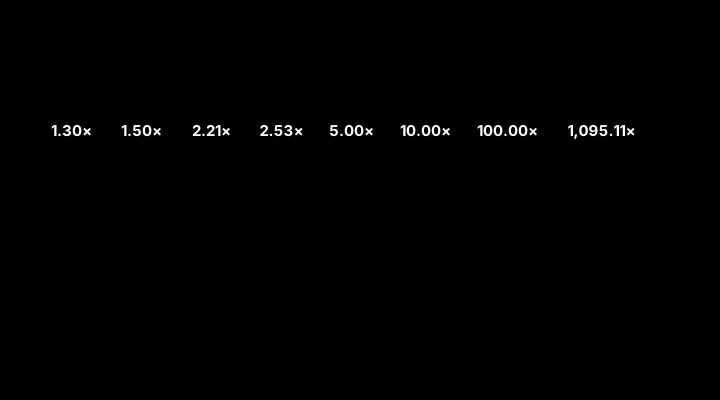
High rounds occur on their own. On the fun-mode screens behind this site, the history strip showed a round of 1,095.11×, which is a round that happened, not a ceiling or a sign of interference. Spribe prints no top multiplier. The strip colours it red because it is 100× or more, while results below 10× show blue and those from 10× to under 100× show purple, and none of those colours is a signal about what comes next.
What an aviator hack costs when it changes nothing
Nothing changes in the round, yet plenty changes around the buyer. The typical costs, described generally:
- Payment for access. A fee for the file, script or channel, often followed by an “upgrade” once the first version fails.
- Credentials. Tools that claim to act on a casino account ask for its username and password, which hands control of the balance to a stranger.
- Device access. A sideloaded package can request permission to read text messages, draw over other apps or use accessibility services, which is enough to capture one-time codes.
- Wallets. A phone running Easypaisa, JazzCash or a crypto wallet exposes those accounts to the same permissions.
- Bigger stakes. Believing a round is under control encourages larger bets, and the 3% house edge applies to every one. At Rs 1,000 a round for 360 rounds an hour, turnover reaches Rs 360,000 and the expected cost Rs 10,800.
The same sellers often claim foresight as well, and why reading a round early fails is covered separately. Files that lock a guess behind a fee get their own treatment in the page on packages sold with paid keys.
How Spribe distributes Aviator
Spribe supplies the game to casino operators, who host it in their lobbies and hold the accounts. The studio does not publish a player app, and its public site offers only a Play Demo button on a play balance. A tool promising to sit between a player and an operator's server is therefore an outsider's product claiming a position that does not exist.
More on the company, the seed construction and how to confirm a finished round is on the studio page.
Better uses of the time
- Watch rounds on the free demo to see how results scatter without anyone steering them.
- Read the return arithmetic in rupees before deciding a stake.
- Set a budget and a time limit before a session, and stop at whichever comes first.
- Gamblers Anonymous offers meetings internationally for anyone who wants help stopping.