Coins, networks and balances
The Aviator crypto game: coins, networks, minimums and cash-outs
Paying for Aviator in coin changes the route money takes and the unit a balance is counted in. The round, its 97% return and its seed check stay exactly as they are in any other currency.
Aviator crypto play is the ordinary Spribe game with a different way of getting money in and out. The coin travels over a public network to an address the casino gives, lands on a balance, and from there every round is priced and settled like any other.
What the coin changes is practical: which network to use, how small a transfer can be, what the balance is worth tomorrow and how a cash-out leaves. What it never changes is the round. The sections below take those parts one at a time.
How an Aviator crypto deposit reaches the balance
A casino's cashier shows a deposit address for one specific coin on one specific network. The sender copies that address into a wallet, chooses the same network, and sends. The transfer then waits for confirmations on the chain, and the casino credits the balance once it has seen as many as its own rules require. Coin payments are just one route into the fuller aviator game online picture covered on the home page.
Two mistakes cost money at this step, and neither can be undone by the casino's support desk as a matter of course:
- The wrong network. A coin sent over a network the address does not belong to may never arrive on the balance, and it can be lost outright.
- Too small a transfer. Operators set a minimum per coin. Bitcasino.io's cl. 5 does exactly that and treats a deposit below the minimum as void.
Copying an address by hand invites a typo, so pasting it and comparing the first and last few characters is worth the extra seconds. A transfer also cannot be recalled once broadcast; the chain has no cancel button, and the casino only sees what arrives. The safe habit is dull but effective: match the coin, match the network, check the minimum, and send a small first amount before a large one. None of this touches the game. It is plumbing that ends where the balance begins.
Stakes shown in coin and stakes shown in fiat
Once credited, a balance can be displayed in the coin itself or converted into a fiat figure, depending on how the lobby is built. The game does not care which. It multiplies whatever unit it is given.
The arithmetic from the fun-mode screens holds in any unit. A stake of 4.60 collected at 2.21× works out to 10.166, and 10.16 was credited, so the third decimal was dropped in that observation. A stake of 100.00 collected at 2.53× returned exactly 253.00. Written in USDT, that is 100 USDT in and 253 USDT out; written in rupees as pure arithmetic, Rs 500 at 2.21× makes Rs 1,105.
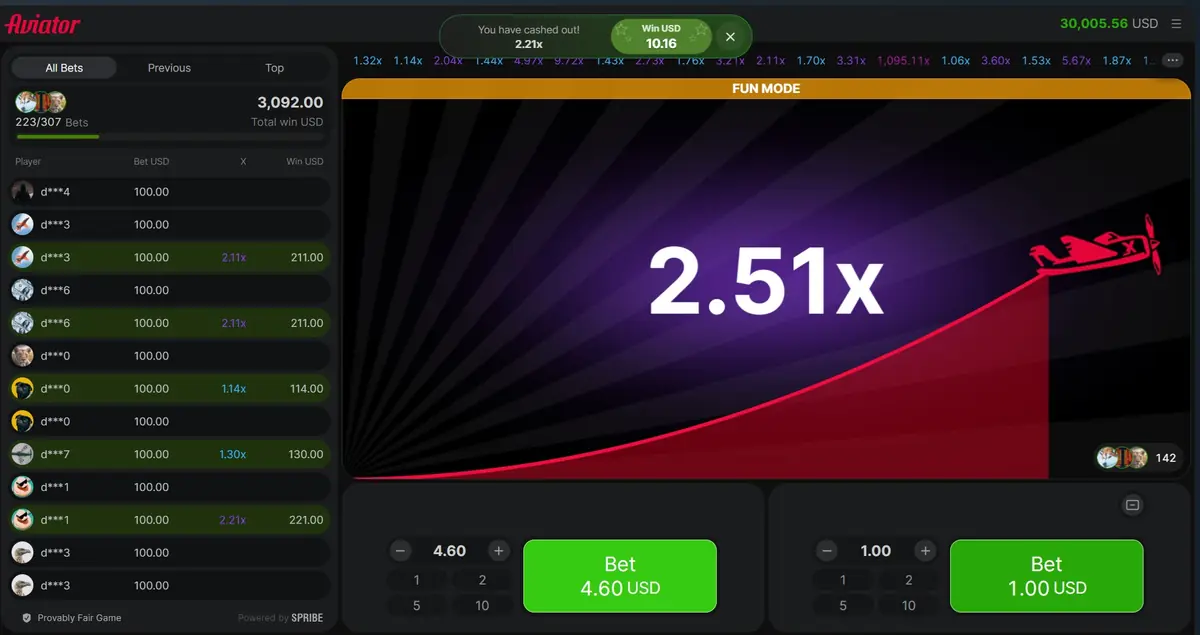 Own capture, fun mode, 7 September 2026, resized and re-encoded and otherwise untouched.
Small coin units deserve a second look before betting. A stake written with many decimal places is easy to misread, and one misplaced digit changes the stake tenfold. Two independent bet panels sit under the round, each with its own stake field, so both need checking.
A balance that moves without a single round
A Bitcoin balance has a second source of change besides play: the price of Bitcoin. If the coin loses 10% against the dollar overnight, a balance of 0.01 BTC is still 0.01 BTC, yet it buys 10% less when turned back into fiat. The reverse happens on a rising day.
That makes results harder to read. A session can finish ahead in coin and behind in fiat, or the other way round, with nothing about the Aviator crypto game itself explaining the gap. Keeping a note of the fiat value at deposit time is the simplest way to see what the rounds did and what the market did. A limit set in dollars rather than in coin avoids the trap of a budget that quietly grows or shrinks with the market.
Stablecoins and what they remove
USDT is built to track the US dollar, so a USDT balance mostly removes that price swing. A session counted in USDT reads the same the next morning, which makes limits easier to keep.
Stablecoins do not remove the other rules. The address still belongs to one network, a minimum still applies, and a transfer on the wrong chain is still at risk. Several operator clauses are written in USDT, which makes them easy to compare directly.
Aviator crypto cash-outs and the clauses behind them
A cash-out in coin runs the deposit route in reverse: a withdrawal address, a network choice, and the operator's own conditions before anything is sent. The address and network need the same care as before, because a coin sent to the wrong chain is just as hard to recover on the way out.
The conditions sit in each casino's terms, with clause numbers:
- Bitcasino.io's cl. 6.10 lets large requests run as high as 1 million USDT in a week.
- Winz.io caps withdrawals at 100,000 USDT a week and 400,000 USDT a month (cl. 11.7).
- Vave sets no cap per period, although a win of 50,000 USDT or more may be split into equal instalments (cl. 8.8).
- At Vave, cl. 8.7 also permits an ID request before any payout, and under cl. 8.11 money paid in has to be bet through three times on casino games before it may be taken out.
A coin payment has no bearing on identity clauses. Where a casino's terms allow a document request, the request can come whichever way the money arrived. More on how the listed casinos word those checks is on the ranked list with its five checks.
Which numbered casinos print an Aviator crypto coin list
Among the twelve scored casinos, six print a list of accepted coins that could be counted:
| Casino | Coin list in the terms or cashier |
|---|---|
| Wolfbet | 32 on the list |
| Bitcasino.io | 12–13 on the list |
| Winz.io | 12 on the list (cl. 4.1) |
| BetFury | 11 named, list left open |
| Winna | 10 named, list left open |
| Sportsbet.io | 5 named, list left open |
A long list is a convenience, not a quality mark, and it sits outside the score. What decides the order of the list is set out on the page explaining the five checks.
The Aviator crypto game round is the same round
Coin or rupee, the round works identically. Spribe publishes a return of 97%, which leaves a house edge of 3% of turnover. The chance of a round reaching a target exit is about 0.97 divided by the target: 48.5% at 2×, 9.7% at 10×. The return figure worked through in rupees shows what that edge costs over an hour.
Fairness does not depend on the payment method either. Before a round, the hash of the server seed is visible in the game's «Provably Fair Settings»; client seeds from players are combined with the server seed and hashed with SHA512 when the round starts; afterwards any round can be checked from the game history. Spribe prints no top multiplier for the game, so no figure for one appears here.
Faster settlement does not speed up the round or improve the odds. Rounds took 10 to 30 seconds on screen however the balance was funded. The step-by-step walk through a round explains the controls. Practising them costs nothing on the free play balance, where no coin needs to move at all. Mobile wallets are a separate route with separate terms, set out on the Easypaisa and JazzCash page.
Gambling is for adults, 18 and over. Set a limit in dollar terms before the first deposit and keep to it; Gamblers Anonymous offers support internationally.