One round, start to finish
Aviator game rules, step by step: stake, climb, cash out, crash
A round of Aviator lasts between ten and thirty seconds and always runs the same way: a bet goes in, a multiplier rises, and the player either collects in time or loses that bet.
Learning how to play Aviator takes about as long as one round, because every round repeats four moves. A bet goes in, a multiplier starts to rise, the player collects or keeps waiting, and the round stops at a number that was settled before anyone pressed a button. The title belongs to the studio Spribe and has been on the market since 2019.
Every figure on this page comes from fun-mode screens captured by the editors on 7 September 2026. Three labels sat on the frame, «Powered by SPRIBE», «FUN MODE» and «Provably Fair Game», so the numbers below are what the game displayed rather than examples made up for a lesson. How those screens were gathered is set out in the notes on sources. For practice with nothing at stake, the free play version behaves in exactly the same way.
How to play Aviator: what is on the screen before a bet
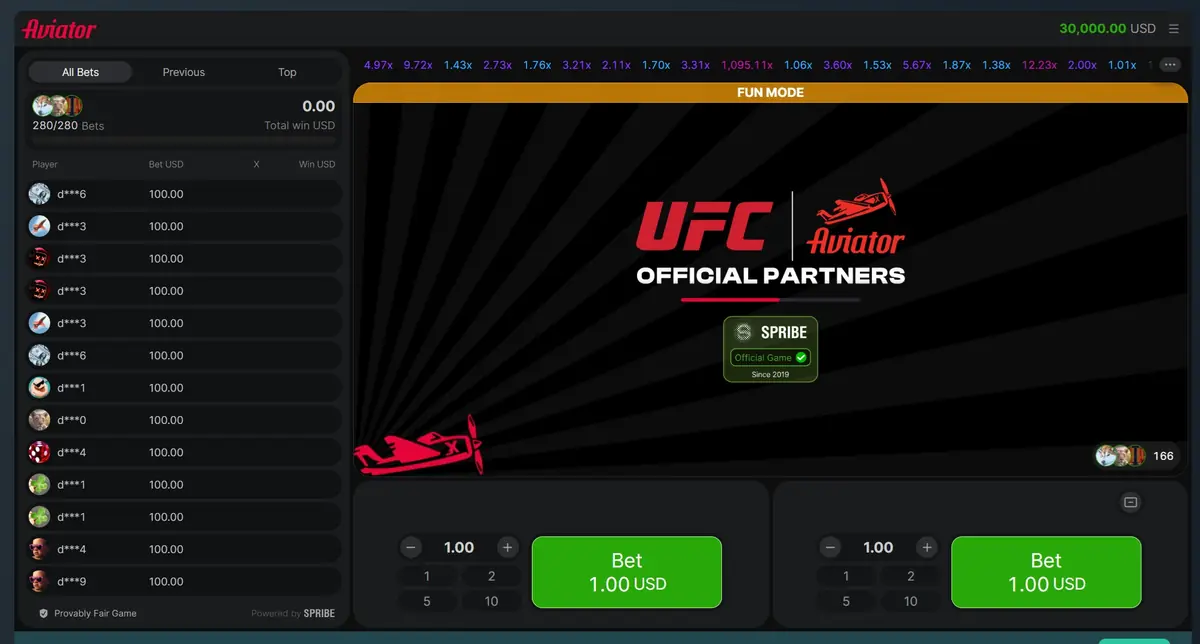
Whoever is working out how to play Aviator game rounds on a phone meets a window that is simpler than it looks at first glance. Most of it is taken up by the playing field where the multiplier climbs. Underneath sit two bet panels, and each one works on its own: a separate amount, a separate button, a separate result.
Each panel has a field for the amount and a row of quick buttons marked 1, 2, 5 and 10, which fill in a round figure with one tap. Above the field runs a strip of finished rounds, newest first. Off to one side, the studio's own page for the game lists chat, live bets and statistics as part of the interface. These round mechanics connect back to the fuller aviator game pakistan picture kept on the home page.
A small counter shows how many players are in the current round. On the three rounds recorded it read 166, then 142, then 173. That number describes a crowd, not a chance: nothing about it moves the point where the round ends.
 Own capture, fun mode, 7 September 2026, resized and re-encoded and otherwise untouched.
Aviator game rules in five steps
The whole cycle fits in a small table. Read it once, then watch a few rounds in free play before any money is involved.
| Step | What you see | What it means |
|---|---|---|
| 1. Betting window | The panel accepts an amount | The amount leaves the balance the moment the bet is placed |
| 2. Take-off | The multiplier starts rising | The end point of this round was already fixed |
| 3. The climb | The number keeps growing | A collect at this moment would pay amount × multiplier |
| 4. Cash-out | You press the button on your panel | The payout is credited at the multiplier shown |
| 5. End of round | The plane flies off | Any bet still inside is lost |
Those five lines are the complete rulebook. There is no hand to build, no card to draw and no second decision after the collect button, which is why the round is so short.
The betting window and your balance
Money moves earlier than many newcomers expect. On the recorded screens the amount came off the balance as soon as the bet was placed, not when the round finished. If the balance looks smaller during the climb, that is the bet already sitting inside the round.
Two panels mean two bets that ignore each other. One can collect early while the other keeps riding; one can be empty while the other is live. A common layout is a small amount set to be collected soon and a second one left to wait, but that choice changes how the result is spread across rounds, not the long-run return of either bet.
If a bet is placed on both panels, the turnover for that round doubles. That matters later, when the cost per hour is worked out. Bets in actual rupees, and what an account holder should know first, are covered on the page about playing for rupees.
Cashing out: the arithmetic the game does for you
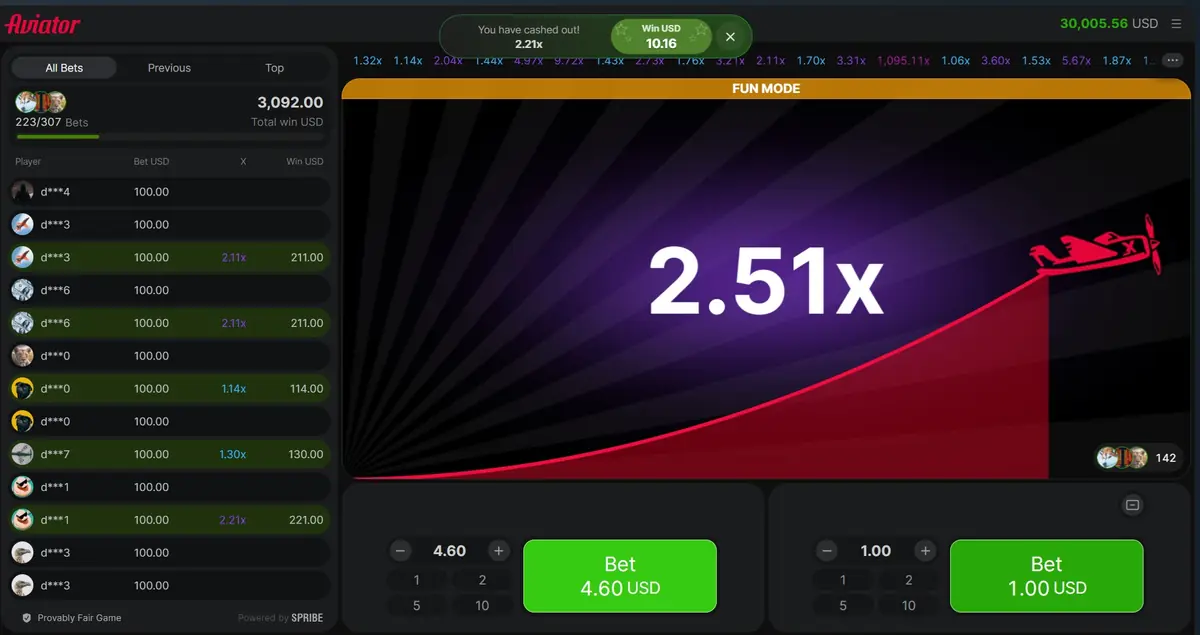
The payout is the bet multiplied by the figure on screen at the moment of the collect. Two recorded rounds show it plainly.
- A bet of 4.60 collected at 2.21×. The product is 10.166, and the balance received 10.16: the third decimal was dropped. That is one observation, not a published rule.
- A bet of 100.00 collected at 2.53×. The balance received 253.00, which is 153.00 more than the amount that went in.
In rupees the sums work the same way. Rs 500 collected at 2.21× returns Rs 1,105, and Rs 1,000 collected at 2.53× returns Rs 2,530. Which currencies a given casino offers and what its smallest and largest bets are depend on that casino, not on the game.
 Own capture, fun mode, 7 September 2026, resized and re-encoded and otherwise untouched.
When the round ends before the button is pressed
Among the recorded rounds, one ended at 1.32× and another at 3.59×. A bet still inside at that moment pays nothing, whatever it might have collected a second earlier.
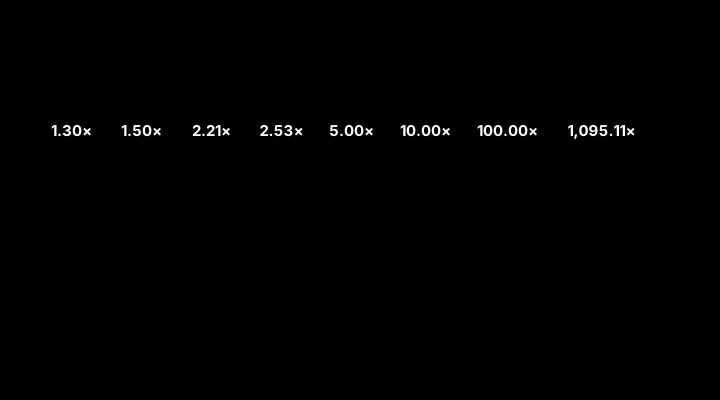
The strip of finished rounds uses three colours. Blue marks a round that ended below 10×, purple one that ended from 10× up to just under 100×, and red one that reached 100× or more. One red entry on the recorded screens read 1,095.11×. That is a round which happened, not a ceiling: Spribe does not publish a top multiplier, and any page quoting one is guessing.
The strip is history and nothing more. Each round is independent of the rounds before it, so a run of blue entries does not make a red one due.
How to play Aviator game sessions with the clock in mind
Rounds of ten to thirty seconds add up quickly. An hour of steady play holds somewhere between 120 and 360 rounds, and every one of them is a separate bet.
The studio states a return of 97%, which leaves 3% of turnover to the house over the long run. At Rs 100 a round, 120 rounds put Rs 12,000 through the game and the expected cost is Rs 360. At 360 rounds the turnover is Rs 36,000 and the expected cost Rs 1,080. The working, and the chance of reaching each target, are laid out on the page about the 97% figure.
A single evening can finish far above or far below those figures. What the arithmetic shows is the direction a long session tends towards, and why a limit set before the first bet is worth more than any choice made during the climb.
Checking that a round was not changed
Aviator publishes how each result is produced. The casino generates a server seed, and a SHA256 hash of the seed for the next round is visible in the player's «Provably Fair Settings» before that round starts. Players supply client seeds. At the start, the server seed and the client seeds are combined and hashed with SHA512, and the multiplier is derived from that hash.
Afterwards, each round in the game history has a «provably fair» icon that opens the check. A player may also replace their own client seed. More on the construction and the company behind it sits on the studio page.
Aviator game rules in any casino, and what the casino adds
The round described above is identical wherever Spribe's game is embedded. What changes from one lobby to the next is everything around it: the currencies, the bet range, when an identity check begins, and how much can be withdrawn in a period.
Those details sit in each operator's terms, and they deserve a reading before a first deposit. The ordered list on the home page scores twelve casinos on exactly those clauses. For apps that borrow the name and have nothing to do with the studio, see how to tell the copies apart.